

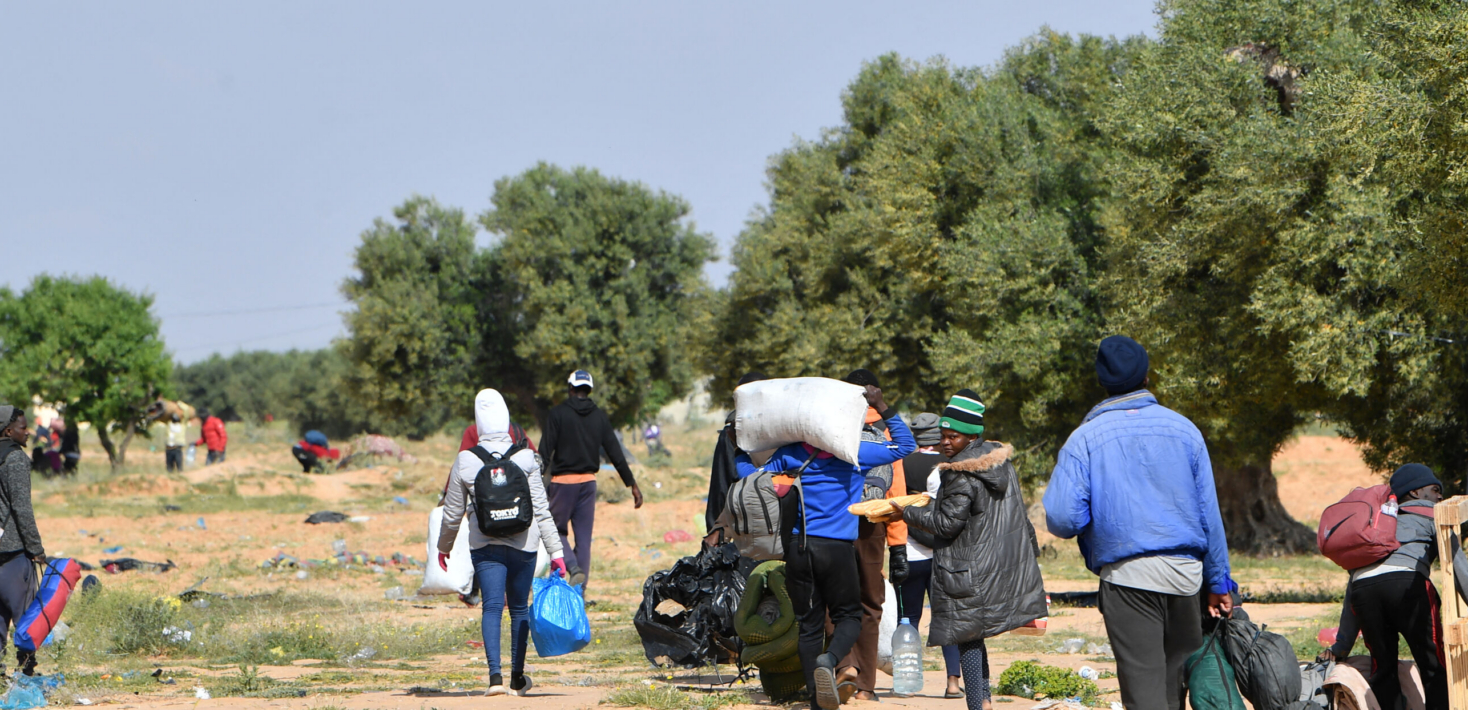


Three years after signing a Memorandum of Understanding (MoU) to strengthen migration cooperation with Tunisia, the European Union (EU)’s unchecked support for border control in the country continues to fuel serious human rights violations against migrants, asylum seekers and refugees, Amnesty International said today.
The European Commission and Tunisia signed the deal on 16 July 2023, despite clear public documentation of a sharply deteriorating human rights situation in the country, including racist abuse and unlawful collective expulsions by the authorities that often involved torture and ill-treatment.
Since then, and despite the continuation of these violations and the 2024 dismantling of the asylum system removing the only avenue for protection, EU and member state officials have remained resolutely committed to strengthening that cooperation, celebrating the resulting significant drop in irregular departures from Tunisia while failing to put in place rigorous and credible due diligence measures, or to embed effective, transparent monitoring or human rights conditionality.
“Despite well-documented evidence of human rights violations against refugees and migrants in Tunisia, the EU looked the other way and signed the MoU without effective human rights safeguards. Since then, the EU has celebrated this migration cooperation as a success despite mounting documentation that the Tunisian authorities continue to subject refugees and migrants to serious human rights violations. These have included dangerous interceptions at sea putting lives at risk, failures to individually assess protection needs of those disembarked in Tunisia, as well as unlawful collective expulsions which have involved torture and other ill-treatment, including rape,” said Heba Morayef, Amnesty International’s Regional Director for the Middle East and North Africa.
Given the scale and severity of ongoing human rights violations, and the lack of any protection avenues with no access to asylum, it is clear that Tunisia cannot be considered safe.
Heba Morayef, Amnesty International
“Given the scale and severity of ongoing human rights violations, and the lack of any protection avenues with no access to asylum, it is clear that Tunisia cannot be considered safe. The EU must act urgently to suspend cooperation on border control with Tunisia and implement strict, credible and effective human rights safeguards.”
In September 2025, the EU delivered two new search-and-rescue (SAR) vessels to Tunisia and in June 2026 President of the European Commission Ursula von der Leyen announced the delivery of three more, in a leaked letter to EU member states, in which she highlighted a 97% decrease in irregular arrivals to Italy since 2023.
In April 2026, in response to a Freedom of Information (FoI) request from Amnesty International, the Commission disclosed that Tunisia and other countries would benefit from a EUR 675 million migration support package between 2025 and 2027.
In November 2025, Amnesty International published a comprehensive report documenting the scale and gravity of violations described above. Those violations have continued while Tunisian authorities have not restored access to asylum procedures.
Intercepted at sea and unlawfully expelled
Recently the organization spoke to seven asylum seekers intercepted at sea off the coast of the eastern city of Sfax then subjected to unlawful collective expulsions to Libya or Algeria between December 2025 and April 2026.
Amin from Sudan and Ibrahim from Cameroon, both asylum seekers, described how they were intercepted at sea by the Tunisian coastguard in February and March 2026 respectively, then expelled by the National Guard to Libya along with dozens of others to be detained and ransomed.
Amin said: “The [Tunisian] coastguard kept circling and circling our boat, creating waves until they made it capsize… We were 38 people with children, all of us fell into the water, without life jackets, I think maybe 20 people drowned… [The coastguard] only took those that survived… I still cannot sleep as I remember that moment.”
Ibrahim shared: “[After our disembarkation, National Guard agents] kicked us and beat us with black pipes, to punish us from taking to the sea… They drove us to a station near the Libyan border, there they beat everyone for 20 minutes at least with iron rods, they nearly broke my hand… We ended up in the [Libyan] detention centre of Al Assah.”
Khedija, asylum seeker from Eritrea, single mother with three children, recounted her interception in April 2026 before the National Guard collectively expelled her and others to Libya:
“At the port they took all our belongings, one agent slapped me because I did not want to give my phone… They made us strip naked outside, they searched inside me in the front and in the back… They beat the men, kicked them and punched them with their hands tied…
“We drove to a [National Guard] station in the desert at night, we stayed there three days… No milk or diapers for the babies, they stayed dirty… The [National Guard] made the men do push-ups for a long time each day, repeating “no Black people in Tunisia”, they would hit them if they stopped… [In Libya] armed men flogged me every day for a ransom until another woman helped me pay.”
Monitoring measures announced or adopted by the EU have so far failed to lead to improvements for refugees and migrants.
Since 2023, the Commission announced that “dedicated monitoring mechanisms” would be put in place but has failed to provide information about how they operate or any details of their mandate, resources, or findings.
The Commission also informed Amnesty International in its April 2026 response that it had finalized an “internal procedure for handling allegations of human rights complaints.” However, information on this procedure, the number of allegations received and their outcomes have not yet been made public. In April 2025, the Commission also issued internal human rights guidance for EU funded external migration programmes; however, the document is not publicly available, raising questions about its effective impact and implementation.
“The stories we hear from refugees, asylum seekers and migrants trapped in Tunisia expose the human cost of the EU – Tunisia migration partnership built on containment rather than protection. The EU cannot keep looking the other way while it evades its human rights obligations and its migration cooperation continues to fuel such serious violations. This cooperation on border control must come to an end,” said Heba Morayef.