

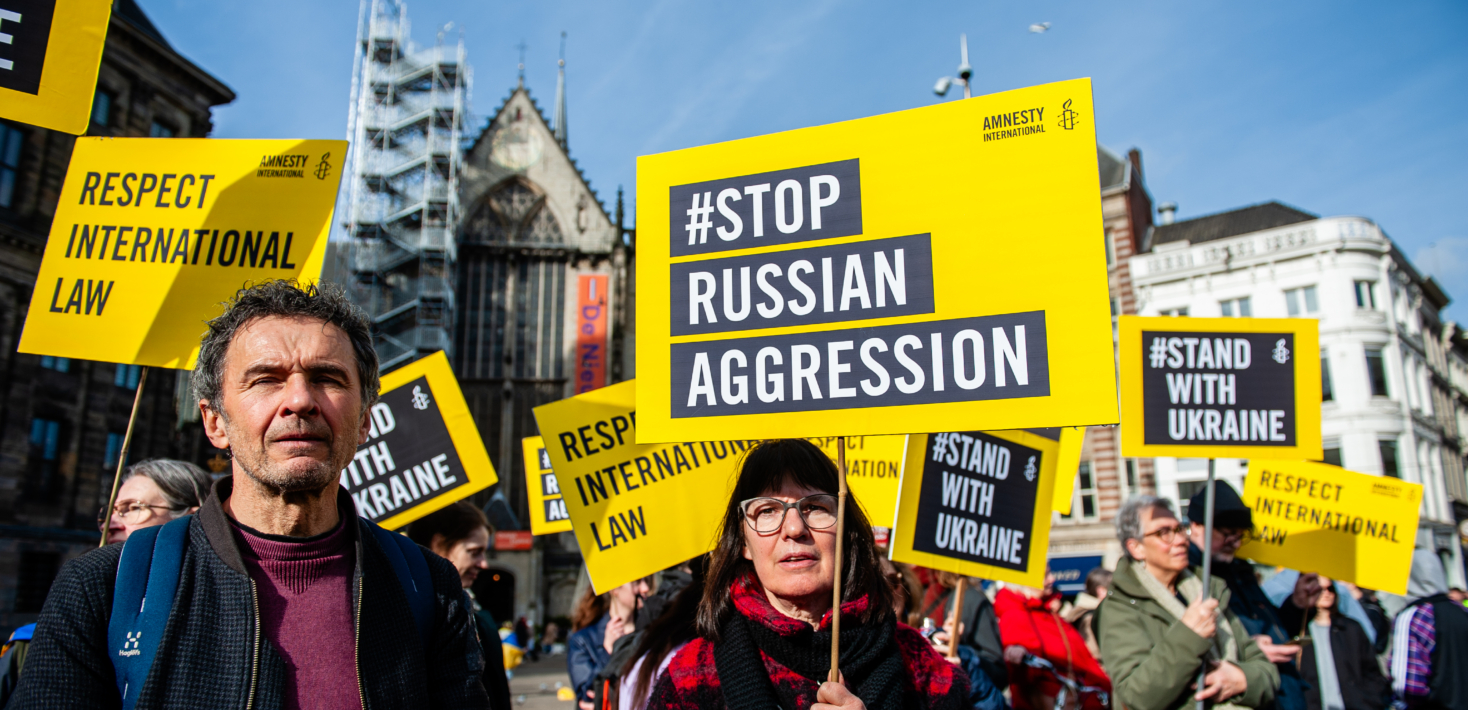


As we mark four years since Russia’s full-scale invasion of Ukraine and 12 years since its initial military intervention, Amnesty International issued the following letter to High Representative Kallas and EU Foreign Ministers, outlining our key calls to the European Union and its member states.
Dear High Representative/Vice-President Kallas,
Dear Foreign Ministers of European Union (EU) member states,
This year marks four years since Russia’s full-scale invasion of Ukraine and 12 years since its initial military intervention. Russia’s aggression, its ongoing violations of human rights and international humanitarian law in the occupied territory of Ukraine and its illegal annexation of those territories constitute a sustained assault on the foundations of the international legal order. At a time when powerful actors across the globe are increasingly emboldened to disregard international law, the European Union’s commitment to defending justice, accountability and the multilateral rules-based order must not falter. Now more than ever, we urge you to uphold the rights of the countless victims of Russia’s aggression to justice, accountability, and reparations, and to firmly reject any attempt to normalize impunity for crimes under international law.
Russia’s war of aggression continues to be characterized by a flagrant disregard for human life and international law. Over the past year, Russia has sharply escalated its indiscriminate as well as direct attacks on civilian infrastructure and civilians, leaving the people of Ukraine to endure yet another year of immense suffering and widespread destruction. Indeed, 2025 was the deadliest year for civilians since the full-scale invasion in 2022 and Ukrainian civilians continue to face relentless indiscriminate attacks.
Meanwhile, Russia’s systematic and deliberate targeting of Ukraine’s energy infrastructure has left Ukrainians facing some of the most severe humanitarian consequences yet. By deliberately targeting and destroying Ukraine’s energy infrastructure, millions of civilians have been forced to cope with dark nights and severe freezing conditions without heating, electricity or water. These attacks disproportionately impact vulnerable groups, including children, older people, and hospital patients. Concretely, this has meant patients facing disruptions in access to life-saving equipment and procedures in hospitals and older persons or people with disabilities, left isolated or confined to their homes due to stalled elevators and disruptions in mobile telephone networks. The sheer scale and intensity of Russia’s attacks on Ukraine’s energy infrastructure appear to be part of a strategy intended to spread terror among the civilian population and undermine resilience. Targeting civilians and civilian infrastructure is a clear breach of international humanitarian law and constitute a war crime. All suspected crimes under international law should be promptly, thoroughly, and impartially investigated and those responsible must be held accountable.
Beyond deliberate and indiscriminate attacks, Amnesty International has documented widespread violations of international human rights and humanitarian law in the occupied territory of Ukraine and beyond, including acts that amount to war crimes and crimes against humanity. Russia has forcibly transferred and deported thousands of Ukrainian children and civilians into Russia or Russian-occupied areas and subjected Ukrainian prisoners of war and civilians in Russian custody to systematic and widespread torture, prolonged incommunicado detention, enforced disappearance, extrajudicial executions and other inhumane treatment which, in combination with the widespread attacks on the Ukrainian civilian population, amount to war crimes and crimes against humanity. While Russia demands control over further Ukrainian territory in ongoing ‘peace negotiations’, teachers in the occupied territory continue to be subjected to forced labour, children face indoctrination and the denial of quality education, and ethnic Ukrainians, Crimean Tatars and other minorities face brutal suppression of their identities and other policies aimed at altering the demographics in the occupied territory.
In 2022, the EU and the international community responded to Russia’s aggression with rare clarity and unprecedented steps to hold perpetrators of international crimes to account. However, as the war drags on, political and economic dynamics in Europe, shifting US positions under President Trump and threats of aggression in other parts of the world, have placed international resolve to oppose Russia’s aggression and support its victims under mounting pressure. International commitments to uphold justice and human rights are being strained as influential actors become increasingly willing to flout international law and further weaken the rules-based order. This is evident in the US administration’s rhetoric minimizing Russia’s responsibility for serious violations; in proposals suggesting that impunity for aggression and other crimes is an acceptable price to pay to end the fighting; and in both the US and Russia’s reckless attacks on the International Criminal Court (ICC), which constitute an affront to all victims and survivors who look to the ICC for truth, justice and reparations.
Pressure on Ukraine to compromise on justice for war-related crimes or accept Russia’s territorial and other demands is unacceptable. Any proposal that ignores justice and human rights will fail to deliver a ‘just and lasting peace’.This would deny scores of victims and survivors their rights to truth, justice and reparations, while prolonging the agony and ongoing suffering of Ukrainian civilians. Moreover, as history has shown, negotiations that sideline human rights and leave perpetrators unaccountable for their crimes, only embolden aggressors and sow the seeds for future cycles of violence and destruction. Rather than appeasing or accommodating such approaches, EU leaders should firmly and actively reject any proposals to normalize impunity. Instead, they should ensure that ongoing negotiations are firmly grounded in respect for international humanitarian law and international human rights law and the EU’s stated principle that justice and accountability are indispensable to achieving lasting peace and security. Injustice must be resisted, not normalized. Impunity must be challenged, not entrenched in peace proposals.
Despite the EU leaders’ continued commitment to international justice in Ukraine, their failure to express support for the ICC in recent European Council statements on Ukraine or to take concrete action to shield the Court, its staff and all actors cooperating with the ICC from sanctions – by, for example, activating the EU blocking statute – sends a deeply troubling message amid continued attacks on the independence and integrity of the ICC. Moreover, statements by EU member states suggesting that they could temporarily suspend clear and fundamental Rome Statute obligations to arrest those subject to ICC warrants in order to host peace negotiations, have no basis in the ICC Rome Statute and would not be consistent with states parties’ obligations. Meanwhile, the initially strong and unified EU protection framework extended to displaced Ukrainians is also facing growing pressure, as some EU member states begin to limit or scale back assistance to Ukrainian refugees, with some even suggesting that parts of Ukraine are safe for return.
This is a critical moment for humanity. The EU’s resolve to stop the Russian aggression, prevent impunity for those responsible for crimes under international law, and secure justice for victims must not falter amid geopolitical shifts and global uncertainty. It is paramount that the people of Ukraine receive truth, justice and reparations for the devastating impact this war has inflicted over the past 12 years — and continues to inflict on the country, its people, its land, and its future.
Amnesty International therefore calls on the EU and its member states to:
- Take concerted action to shape ongoing diplomatic negotiations on Ukraine and ensure that broader EU efforts in pursuit of a ‘just and lasting peace’ are firmly grounded on international humanitarian law, international human rights law and an unwavering commitment to international justice and accountability.
- Reinvigorate EU action to achieve justice for all crimes under international law including by committing to:
- Full and unconditional EU support to the ICC: Beyond commitments to guarantee the establishment and effectiveness of the Special Tribunal on the Crime of Aggression, the register of damage and the International Claims Commission, the EU should express its full and unconditional support to the ICC as a cornerstone of the international criminal justice architecture and the only permanent international court with a mandate to investigate and prosecute individuals for war crimes, crimes against humanity and genocide. In line with recent commitments and the EU and all its member states’ legally binding obligations, EU leaders should commit to safeguarding the independence and integrity of the Court and guarantee full cooperation with the Court across all situations, including by affirming their obligation under the Rome Statute to enforce arrest warrants against persons indicted by the ICC who enter their territory. EU leaders should also take decisive action to protect the Court, its staff and those cooperating with the Court, including civil society, from U.S. sanctions and other threats by activating the EU blocking statute and adopting similar instruments at national and regional level, that aim to shield European operators from the effects of extraterritorial sanctions and ensure the continuity of funding to the Court and those cooperating with it.
- Initiate and further strengthen domestic investigations into core crimes under the principle of universal jurisdiction in EU member states. This would entail ensuring that adequate resources and political support is provided to domestic investigative and prosecutorial bodies investigating and prosecuting crimes under international law, and wherever possible conducting ‘structural investigations’ into the Ukraine situation, as well as replicating this approach in relation to other situations.
- Provide full political and practical support to the UN-established Independent International Commission of Inquiry on Russia’s invasion of Ukraine, including by galvanizing wide support for the renewal of the mandate at the upcoming session of the UN Human Rights Council.
- Further strengthen Ukraine’s justice architecture and its capabilities to investigate and prosecute international crimes as part of Ukraine’s EU accession process and the technical and financial support foreseen under the Ukraine Facility.
- Guarantee the rights of victims and survivors of crimes under international law in both domestic and international proceedings. This should include providing effective support to victims, promoting their or their representatives’ meaningful participation in the investigation and prosecution of international crimes and guaranteeing their access to reparations. It should also include ensuring victims and survivors are meaningfully involved in discussions over peace, reconstruction and the future of Ukraine.
- Ensure that the plight of Ukrainian children, civilian detainees, and prisoners of war is addressed in ongoing negotiations: This includes maintaining consistent international scrutiny over the plight of Ukrainian children and other civilians forcibly transferred or deported to Russia or Russian-occupied areas, Ukrainian civilians unlawfully detained in Russian custody, and the situation of prisoners of war on both sides, including the torture and other inhumane treatment of Ukrainian civilian detainees and prisoners of war. EU leaders should ensure ongoing diplomatic efforts seek:
- The immediate release of all Ukrainian civilians unlawfully detained in Russia or Russian-occupied areas.
- The return of all unlawfully transferred or deported Ukrainian children and other persons.
- The repatriation of all gravely wounded or gravely sick prisoners of war, in line with the Third Geneva Convention.
- The establishment of mixed Medical Commissions to evaluate the medical needs of prisoners of war.
- Access to prisoners of war for international humanitarian organisations, including the ICRC.
- Scale up and guarantee the long-term sustainability of relief, recovery and reconstruction assistance to the people of Ukraine.
- Support Ukraine in protecting and building a more resilient, civilian energy infrastructure, including by supporting flexible assistance efforts aimed at addressing the dire humanitarian effects of Russia’s systematic attacks on Ukraine’s energy infrastructure. EU leaders should commit to providing Ukraine vital energy and other civilian supplies and oppose any attempts to use them as leverage against Ukraine.
- Refrain from rolling back support to Ukrainian refugees foreseen under the Temporary Protection Directive and guarantee that efforts to ensure an EU-wide, coordinated transition out of temporary protection offers displaced individuals from Ukraine a more durable status and pathway to long-term residence. This support should be provided to all refugees fleeing Ukraine, without discrimination of vulnerable groups such as third-country nationals, Roma refugees, stateless persons, and people who were seeking asylum or holding international protection status in Ukraine.
- Defend the universality of human rights and the international legal order in the EU’s broader foreign policy. More than ever, the world needs constructive, consistent and principled human rights leadership. EU leaders should respond to all attacks on the international legal order with equal vigour and consistently uphold respect for international humanitarian and human rights law, across all conflicts and in all their partnerships with third countries.
Many thanks in advance for your continued action on human rights.
Yours sincerely,
Eve Geddie
Director
Amnesty International – European Institutions Office