

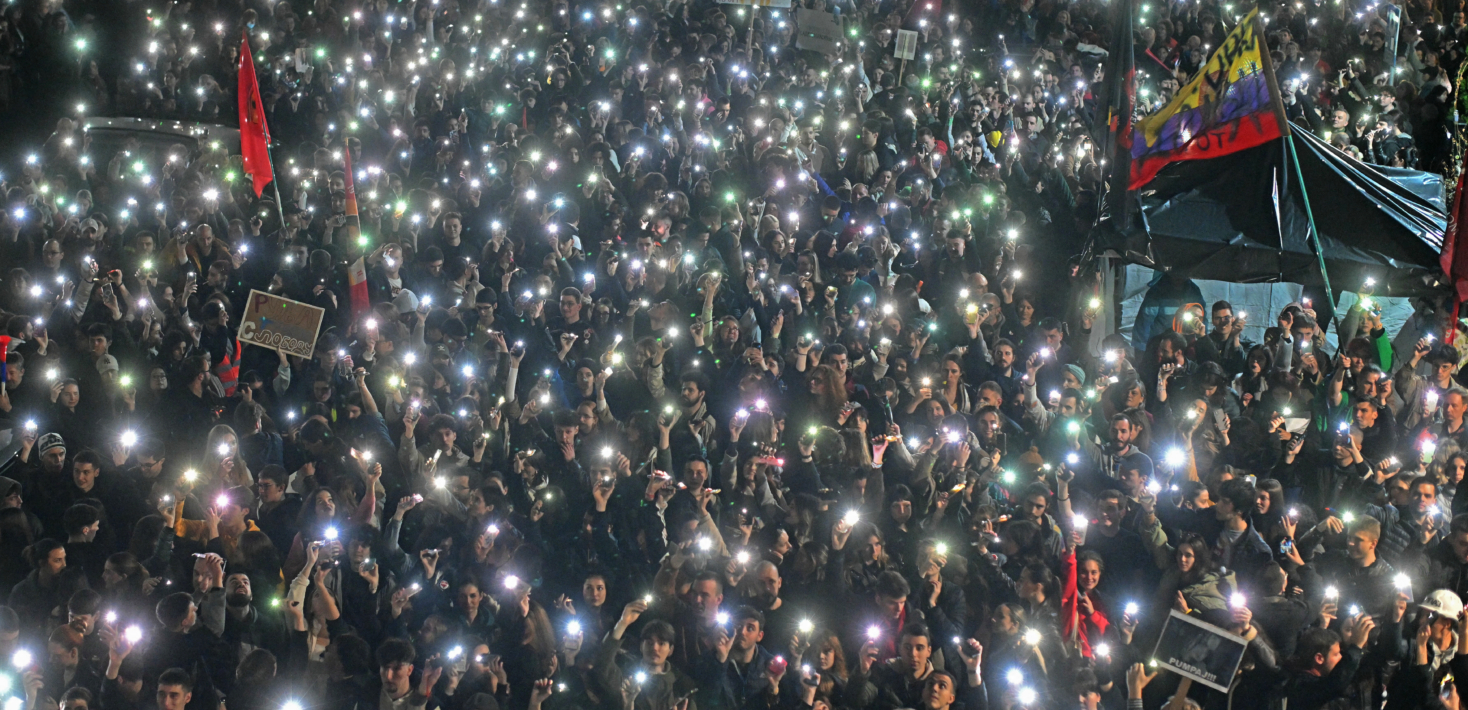


Amnesty International is presenting this submission to the European Commission ahead of the preparation of its 2026 Enlargement Package. It details Amnesty International’s human rights concerns and outlines key recommendations that the EU should prioritize in the framework of Serbia’s EU accession process as well as any other ongoing engagement with the authorities.
The reporting period (May 2025 – April 2026) has been marked by a continued deterioration of human rights and the rule of law in Serbia, amid sustained protests and widespread civil unrest. The collapse of a concrete canopy at the train station in Novi Sad in November 2024, which resulted in the deaths of 16 people, acted as a catalyst for prolonged public discontent. In the months that followed, hundreds of thousands of people participated in protests across the country, frequently blocking roads and public institutions while demanding accountability for the incident and calling for early elections.
Rather than engaging with protesters’ demands, the Serbian authorities chose to respond by doubling down on repressive measures, targeting the protest movement, journalists, civil society groups, students and increasingly also the broader academic community. Indeed, during the reporting period government repression has taken the form of police violence and the excessive use of force against protesters, arbitrary arrests and detentions, unlawful surveillance, serious and unfounded criminal charges and escalating disinformation and smear campaigns.
Although the demands initially driving the protests closely aligned with Serbia’s EU accession commitments, the EU’s perceived complacency toward Serbia’s long-standing human rights backsliding in previous years, undermined the EU’s credibility as a human rights actor and reinforced Serbian civil society’s sense of isolation. However, over the past year, tentative shifts have emerged in the EU’s approach towards Serbia. This has included a stronger emphasis on human rights and rule of law reforms in high level public engagements by the President of the European Commission, the High Representative and the Commissioner for enlargement, as well as a more explicit linkage between EU financial assistance and reforms in the field of fundamental rights and the rule of law. However, to meaningfully support human rights reform, this shift must now translate into decisive EU action and a more sustained policy approach which firmly anchors Serbia’s accession process in respect for the rule of law and fundamental rights.
Efforts to promote fundamental rights and the rule of law should be at the forefront of Serbia’s EU accession process. The EU and its member states should ensure that their engagement with the Serbian authorities as well as the technical and financial support foreseen within the framework of Serbia’s EU accession process are used more effectively to foster concrete human rights and rule of law progress and to ensure the meaningful involvement of Serbia’s civil society in the reform process.
More specifically, the EU should ensure that achieving tangible progress on human rights – in both law and practice – remains at the center of any decisions to open new negotiation clusters with Serbia and to disbursing EU funding under IPA III and the Growth and Reform Facility. Further EU funding should also be directed to promoting civil society space and supporting these actors in their crucial work. As part of its efforts to promote civil society space, the EU should insist on the meaningful involvement of civil society in the elaboration of human rights benchmarks linked to EU funding and in the monitoring and tracking of Serbia’s delivery on these commitments.
This briefing covers the following key issues which the EU should address in the framework of Serbia’s EU accession process and other ongoing engagement with the authorities:
- Freedom of assembly and association
- Excessive use of force and police violence
- Arbitrary arrests and detention of protesters
- The opaque role of officers without identification
- Attacks on civil society
- Economic and administrative retaliation
- Freedom of Expression
- Unlawful use of invasive spyware and digital forensic technology
- Lack of accountability for unlawful use of spyware and digital forensic technology