

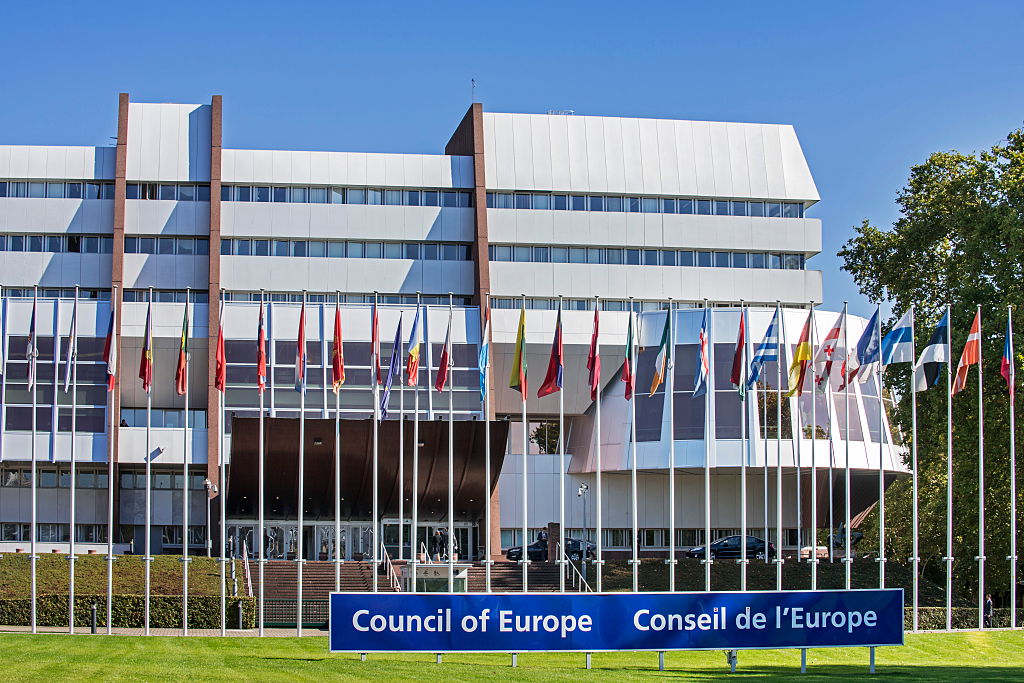


Following months of attacks on the European Convention on Human Rights’ system, Council of Europe member states adopted a political declaration on 15 May that could open the door to a two-tier system where migrants and refugees’ rights would receive less protection.
The declaration is non-binding, but it may signal the beginning of a dangerous roll-back of states’ respect for the integrity of the European Convention on Human Rights’ system. This would lead to a gradual weakening of human rights which could harm all of us. Here’s what you need to know:
What is the European Convention on Human Rights?
The European Convention on Human Rights (ECHR) is a regional human rights treaty. It was adopted in 1950, in the aftermath of World War II, and is the “cornerstone” of the activity of the Council of Europe (CoE), an international organization that is separate from the European Union. The European Court of Human Rights, charged with ensuring states’ compliance with the ECHR, has championed human rights of people living in Europe and beyond.
Founded in 1949, the Council of Europe protects human rights, democracy, and the rule of law. As signatories to the ECHR, its 46 member states have committed to protect people’s rights and freedoms. If states interfere with human rights, individuals can complain to the European Court of Human Rights to challenge alleged violations of the ECHR.
What is the declaration adopted in Chișinău, Moldova on 15 May 2026?
On 15 May, Council of Europe foreign ministers met in Chișinău, Moldova to adopt a political declaration on the ECHR and migration, that threatens the future of migrants and refugees’ rights under the Convention and the absolute prohibition of torture and other ill-treatment.
The declaration describes the “challenges” that states claim they face when managing migration in compliance with their obligations under the ECHR and seeks to weaken the reach of the Convention in cases involving migrants and refugees, particularly cases of return and deportation.
With the declaration, Council of Europe member states seem intent on laying the foundations for a two-tier human rights system – an affront to the basic principle that human rights are universal.
What are Amnesty International’s main concerns with the declaration?
Firstly, the declaration threatens the basic principle that human rights are universal as it seeks to lay the foundation for a two-tier system where different rules and exceptions would apply in cases involving migrants and refugees’ rights.
In particular, the declaration threatens the rights under Article 3 of the ECHR, which prohibits torture and other ill-treatment. This provision is central to the principle of “non-refoulement”, which prohibits the removal of anyone to a country where they face a real risk of torture or other ill-treatment. This principle applies to everyone, regardless of their migration status or the way they entered a country and irrespective of national security considerations.
The declaration seeks to introduce limits to the application of the standards on torture and ill-treatment in migration and refugee cases, putting the absolute protection afforded under article 3 at risk. Undermining the prohibition of torture and other ill-treatment in migration cases would not only lower the protection for some of the most marginalized people in Europe, but it could also weaken its application in other situations.
Secondly, the declaration addresses the following problematic migration policies without considering the serious human rights’ risks involved:
- When acknowledging “new approaches” pursued by states to manage migration, including so called “return hubs”, the declaration omits how initiatives similar to “return hubs” have so far either been ruled unlawful by domestic courts, or faced repeated legal challenges, and in all cases raise wide-ranging human rights concerns.
- Alarmingly, migration deals with countries outside the Council of Europe region are also acknowledged in the declaration despite the well-documented human rights violations against migrants and refugees in several countries such as Egypt, Libya and Tunisia with whom various CoE member states, and the European Union, cooperate on migration.
- The declaration also addresses so-called “instrumentalization of migration” as situations where migration movements are “deliberately facilitated, encouraged or exploited by a hostile State or other actor […] with the aim of exerting pressure on, destabilizing or undermining another State and European democracies”, and speaks of the “challenges” that states face when confronted with it. Yet, the actions of European states’ when responding to alleged “instrumentalized migration” is currently under the scrutiny of the European Court of Human Rights, which is considering cases against Latvia, Lithuania, and Poland. Amnesty International and others have documented serious violations of human rights in these countries against migrants and refugees, including violent pushbacks and arbitrary detention. As the European Court has yet to rule on the three related cases currently pending on its dock, the declaration could be considered as exerting undue political pressure on the Court.
How does this undermine protections under the European Convention?
For over 75 years, the Convention has guaranteed freedom of the press, and the rights of LGBTI+ people’, minorities, women, people with disabilities, migrants, the environment and many more, in line with the basic principle that human rights belong to all of us. With rising authoritarianism, racism and xenophobia, and as the international legal order faces unprecedented threats, Europe should reinforce the protection of human rights and the regional system that guarantees them – not actively undermine them. When political leaders argue that the level of protection granted in migration cases must be rewritten for a new ‘era’, they are retreating into politics that regard some people as less deserving of rights than others based on their migration status and, ultimately, their nationality and/ or perceived race. This harms us all.
Human rights were designed to address moments like this. When politics of division makes for easy scapegoats and when compassion is portrayed as weakness, these protections exist to prevent us from repeating the worst moments of our history.
Amnesty International will remain vigilant against further proposals that risk undermining the scope of the ECHR.